







Chinese President Xi Jinping arrived in Washington this week for a state visit that could shape the direction of the world’s most important economic relationship for months to come. On the eve of the formal summit with President Donald Trump, Treasury Secretary Scott Bessent said the U.S.-China trade truce has been extended for two months, according to CNBC — a move that removes the immediate risk of escalating tariffs but leaves the underlying disputes unresolved.
For investors, policymakers and economists, the summit arrives at a delicate moment. U.S. Treasury yields are at their highest since 2007, oil is hovering near $100 a barrel and the Federal Reserve is signaling further rate hikes. A trade shock on top of those pressures would be unwelcome; a breakthrough could provide relief.
What’s on the Agenda
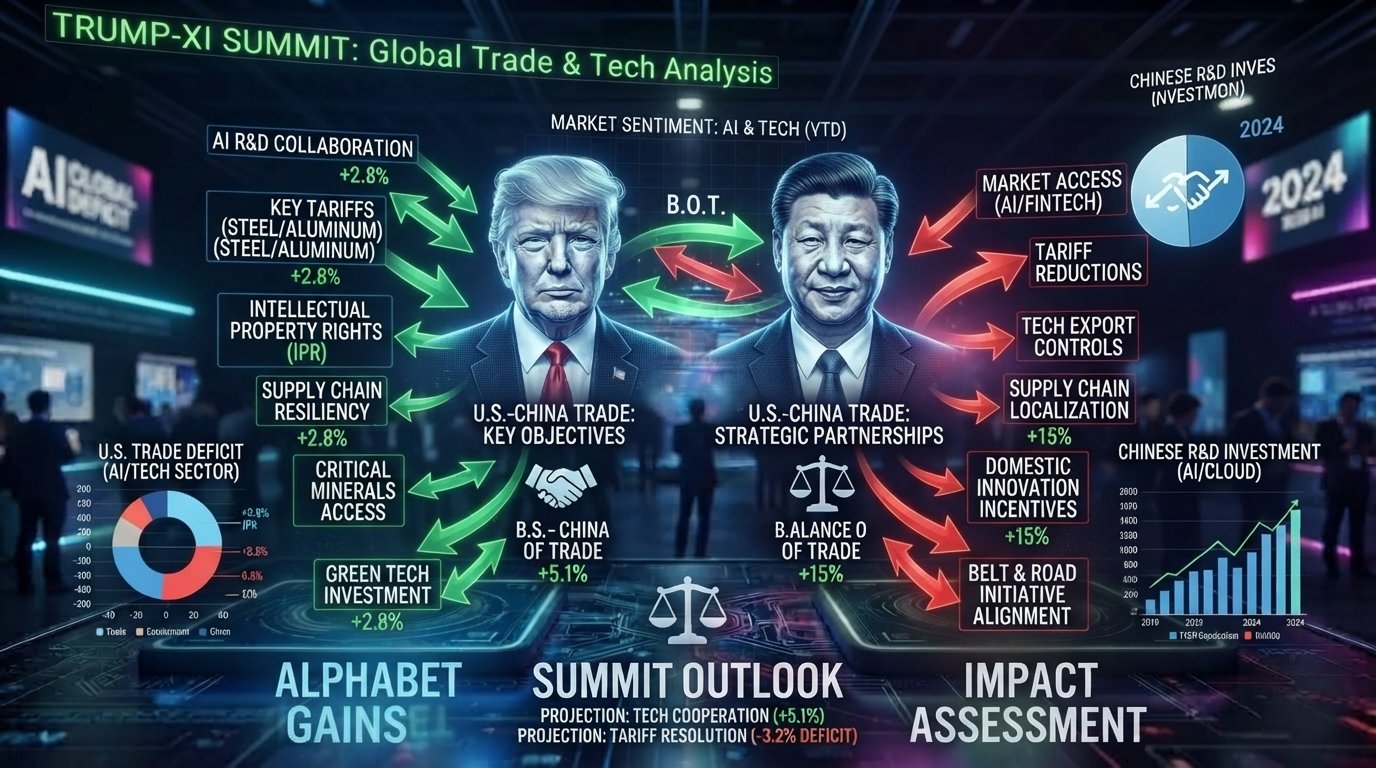
According to Charles Schwab’s market commentary, the Trump–Xi meeting is expected to focus on three core issues: trade, AI safety and Iranian crude. Each has direct implications for markets:
- Trade and tariffs: The truce extension buys time but sets up another deadline roughly two months from now. Markets will watch for any framework toward a longer-term agreement.
- AI and technology: Semiconductor export controls remain one of the most contentious issues. Restrictions on advanced chips affect U.S. companies’ revenue in China and shape the global AI race.
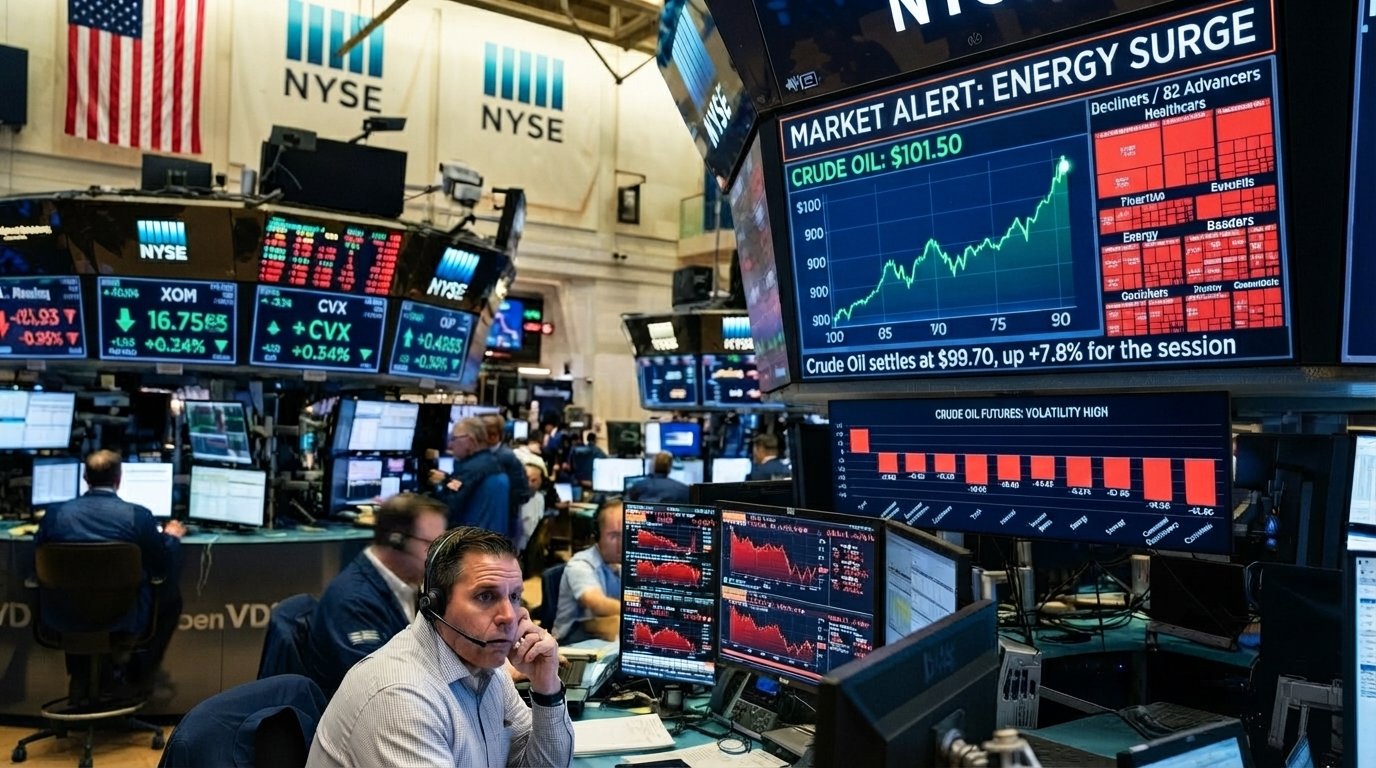
- Iranian oil: China is a major buyer of Iranian crude. With U.S.-Iran tensions pushing Brent above $100 this week, any Chinese cooperation on limiting purchases — or refusal to do so — could move oil markets significantly.
Early Signals Are Mixed
Yahoo Finance reported that Xi arrived with a smaller-than-expected business delegation, which market observers interpreted as a sign of reduced dealmaking prospects. Large delegations of Chinese executives have historically accompanied visits where major purchase agreements — for aircraft, agricultural products or energy — were announced.
Ahead of the talks, China also expanded export controls on certain drug precursor chemicals, according to a report circulated on Finviz. That move can be read in two ways: as a goodwill gesture addressing U.S. concerns about fentanyl supply chains, or as a reminder of China’s own leverage over critical inputs.
How Markets Are Positioned
Finviz data from Wednesday’s session show mixed moves among companies with large China exposure:
| Company | Ticker | Change Sept. 23 | China Relevance |
|---|---|---|---|
| Nvidia | NVDA | −1.47% | Export controls on advanced AI chips |
| Micron Technology | MU | −2.22% | Memory chip sales and past Chinese restrictions |
| Apple | AAPL | −0.80% | Manufacturing base and major consumer market |
| Boeing | BA | +1.12% | Aircraft orders often tied to trade diplomacy |
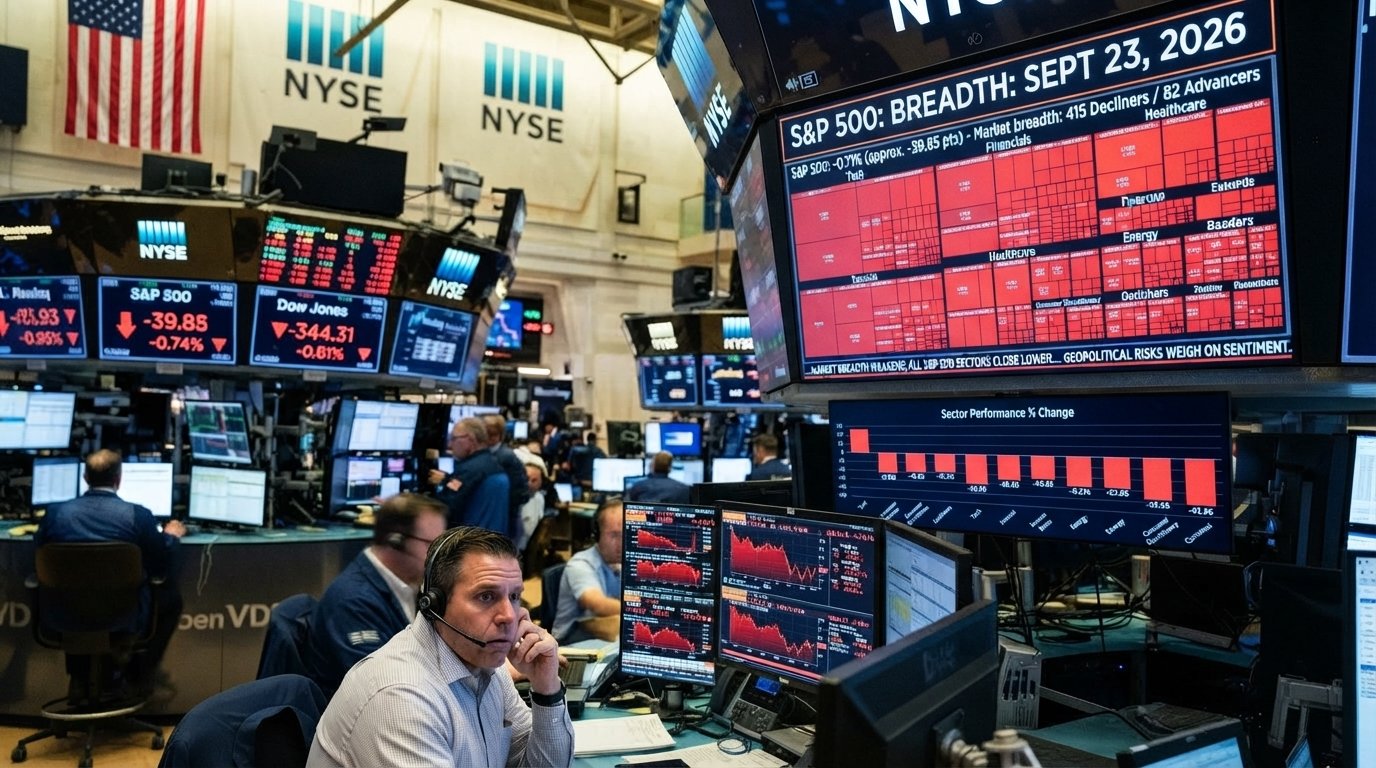
It is difficult to separate summit-related moves from the broader rate-driven selloff on Wednesday, when 72.2% of stocks fell. But Boeing’s gain on a weak day is notable, given that Chinese aircraft purchases have historically been a feature of trade negotiations.
The Chip Question
Semiconductors sit at the center of U.S.-China tensions. One investment research blog on Finviz this week examined “the impact of the US-China chip ban on third parties,” highlighting how export controls ripple through supply chains in countries such as South Korea, Taiwan, Japan and the Netherlands. Another commentary argued that “the real AI threat” is China’s progress in developing its own AI capabilities.
Asian markets are closely tied to this dynamic. Bloomberg reported that Japan’s Nikkei rose on an “AI catch-up rally” even as bond yields climbed, and a macro research blog described South Korea’s KOSPI as “where policy meets the AI trade.” Any change in U.S. chip export policy would be felt quickly across Asian technology stocks.
Investment Pledges and Industrial Policy
The summit also comes as U.S. allies make large investment commitments tied to trade deals. South Korea reportedly picked a $22 billion Texas gas plant as the first down payment on a $350 billion investment pledge to the U.S. These commitments are part of an administration strategy to use tariff leverage to attract foreign investment in U.S. manufacturing and energy. Investors will watch whether a similar framework emerges for China, though political sensitivities make large Chinese investment in the U.S. far more complicated.
Why It Matters for Inflation and the Fed
Trade policy is directly linked to inflation. Tariffs raise the cost of imported goods, and supply-chain disruptions can push up prices across the economy. With the Fed’s projections showing core PCE inflation at 3.4% for 2026 and no return to 2% until 2029, an escalation in tariffs would complicate the central bank’s task. Conversely, a durable agreement that lowers tariffs could ease some goods-price pressure.
The oil dimension is equally important. If China agreed to reduce purchases of Iranian crude as part of broader U.S.-Iran diplomacy, the effect on global oil markets would be complex — potentially tightening supply further in the short run, or supporting a diplomatic resolution that ultimately lowers the geopolitical risk premium. President Trump has described recent U.S.-Iran talks at the U.N. as “very good” and “very productive.”
Scenarios to Watch
- Constructive outcome: Agreement on a framework for a longer truce, possible purchase commitments (aircraft, agriculture, energy) and a working group on AI safety. Likely positive for Boeing, agricultural exporters, semiconductors and Asian markets.
- Status quo: Cordial talks with few concrete results and another deadline in two months. Likely limited market impact, with attention returning to the Fed and bond yields.
- Negative outcome: Public disagreement over chips, Taiwan or Iran, raising the risk of tariff escalation when the truce expires. Likely negative for semiconductors, multinationals with China exposure and emerging markets.
For Policymakers and Economists
The summit underscores how intertwined trade, technology, energy and security policy have become. Tariffs are now just one tool among many, alongside export controls, investment screening and energy diplomacy. For economists, the key question is whether the U.S.-China relationship is stabilizing into a managed rivalry with predictable rules — which markets can price — or remains subject to abrupt shifts that raise uncertainty and discourage investment.
For now, the two-month extension offers a window of calm. Markets will be watching closely to see whether it becomes a bridge to something more durable.
Data source: Finviz quote data and news/blog headlines as of the Sept. 23, 2026 close; summit details from CNBC, Yahoo Finance and Charles Schwab reports. This article is for informational purposes only and is not investment advice.