














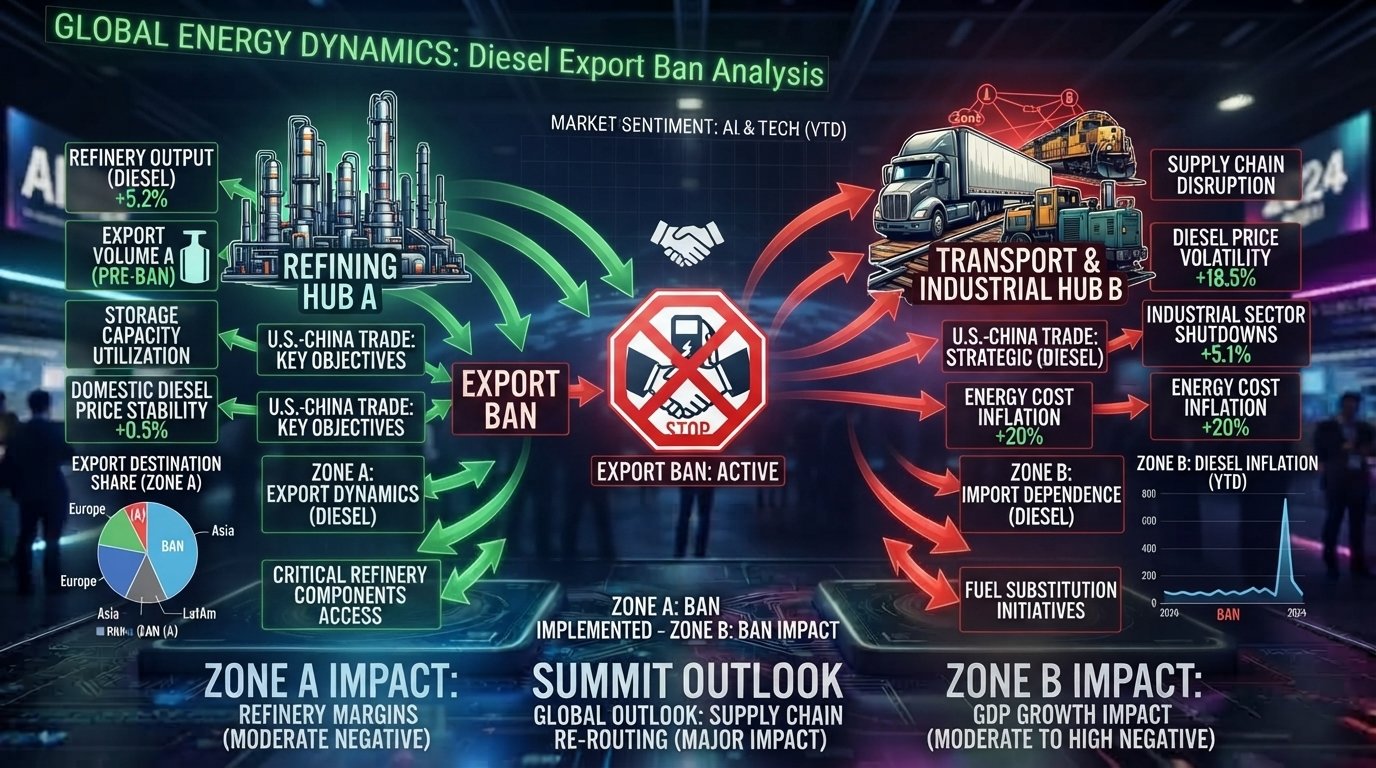
Diesel fuel — the lifeblood of trucking, farming, construction and freight rail — has become the latest flashpoint in U.S. economic policy. With diesel prices setting new records and Brent crude trading near $100 a barrel, Washington is weighing an extraordinary intervention: restricting exports of diesel fuel. The debate pits short-term relief at the pump against the risk of disrupting global energy markets and, according to some analysts, raising gasoline prices at home.
What’s Being Proposed
Several strands of reporting circulated on Finviz this week paint a picture of an administration actively considering its options:
- Bloomberg reported that the U.S. is preparing a plan for a 90-day diesel export ban, citing a separate report.
- Commentary on the Mish Talk blog noted that the Energy Secretary discussed a voluntary cap on diesel exports, not a ban — suggesting a softer approach remains on the table.
- Earlier in the week, a group of Republican senators sought a diesel export ban to halt soaring prices.
- Bloomberg also reported that Morgan Stanley warned gasoline would cost more if a U.S. diesel ban takes effect.
The range of options — from a mandatory ban to voluntary restraint — indicates that no final decision has been made. But the fact that a formal plan is reportedly being prepared marks a significant escalation.
Why Diesel Prices Are So High
The immediate cause is geopolitical. Renewed U.S.-Iran tensions pushed oil up almost 4% earlier this week, and Brent briefly topped $100 on Wednesday. But diesel’s rise reflects more than crude. One commentary circulated on Finviz this week summed it up: “The World Has Oil, but Not Enough Refining.” Refining capacity has not kept pace with demand for middle distillates like diesel and jet fuel, and several refineries in the U.S. and Europe have closed in recent years.
Shipping costs have also exploded. One widely shared analysis this week noted that the average supertanker day rate has climbed to about $1.2 million, up from roughly $29,900 — reflecting disrupted routes and war-risk premiums. Hurricane Polo has additionally disrupted Mexican ports, putting key trade gateways at risk. When it becomes more expensive and difficult to move fuel around the world, regional shortages develop and prices spike.
U.S. refiners, meanwhile, have strong incentives to export diesel to markets where prices are even higher, particularly in Europe and Latin America. That is precisely what an export restriction would aim to stop.
The Case For Restricting Exports
Supporters argue that keeping more diesel at home would increase domestic supply, lower prices for American truckers, farmers and businesses, and ease one of the most visible sources of inflation. Diesel costs feed directly into the price of nearly everything that is shipped by truck or rail, so relief at the diesel pump could ripple through the economy. With the Federal Reserve projecting 2026 headline PCE inflation at 3.7% and raising rates to fight it, any measure that brings down energy costs has obvious appeal to policymakers.
There is also a political dimension. With midterm elections approaching in November, fuel prices are a highly visible pocketbook issue for voters.
The Case Against
Critics — including, implicitly, Morgan Stanley’s analysts — point to several risks:
- Gasoline prices could rise. Refineries produce diesel and gasoline together from each barrel of crude. If export restrictions reduce the profitability of diesel, refiners may cut overall throughput, reducing gasoline supply as well.
- Global prices would likely climb. Removing U.S. diesel from world markets would tighten supply for importing countries, pushing international prices higher and potentially straining relations with allies.
- Investment signals. Export bans can deter long-term investment in refining capacity — the very thing needed to solve the underlying shortage.
- Market distortions. Temporary bans can create price gaps between domestic and international markets, encouraging workarounds and complicating supply planning.
How Energy Stocks Are Reacting
Finviz data show Energy was the only sector to rise on Wednesday, gaining 0.84%. Within it, the Oil & Gas Integrated industry rose 1.64% and is up 40.08% year to date. Oil & Gas E&P gained 1.01%. Integrated companies, which operate refineries alongside production, have benefited from wide refining margins.
An export ban would likely have uneven effects across the sector. Refiners with large export businesses on the Gulf Coast could see margins squeezed, while those focused on domestic markets might benefit from continued tightness. Producers of crude oil could see mixed effects depending on how refinery runs change.
Effects on Fuel-Intensive Industries
Industries that consume large amounts of fuel have been under pressure. Finviz shows the Airlines industry fell 2.84% on Wednesday and is down 3.52% year to date. Bloomberg noted this week that AirAsia’s hunt for cheaper debt won’t be easy “with $100 oil,” illustrating how energy costs are affecting airlines globally. Railroads, by contrast, rose 0.51% on Wednesday and are up 20.98% for the year, supported by strong freight demand and the fuel-efficiency advantage of rail over trucking.
The Venezuela Factor
Supply alternatives are also in focus. Bloomberg reported that Venezuelan leader Rodríguez vowed an “orderly” return to democracy, and investment analysts have been examining the implications of a Venezuelan oil deal. Venezuela’s heavy crude is well suited to many U.S. Gulf Coast refineries, and increased supply could eventually ease pressure on diesel markets — though rebuilding Venezuela’s oil industry would take years.
What Economists Are Watching
For economists, the diesel debate is a case study in the limits of monetary policy. The Fed can raise interest rates to cool demand, but it cannot increase refining capacity or reopen shipping routes. A Capital Spectator analysis circulated on Finviz this week argued that “the path to lower inflation still runs through Iran” — in other words, energy prices driven by geopolitics may matter more for near-term inflation than further rate hikes.
If export restrictions succeed in lowering domestic diesel prices, they could modestly reduce headline inflation. If they backfire by raising gasoline prices, the effect could be the opposite.
What Investors Should Consider
- Watch for official confirmation of any ban or cap, including its duration and scope.
- Monitor refining margins, which drive profits for integrated energy companies and independent refiners.
- Consider the second-order effects on transportation, agriculture and airline stocks.
- Track U.S.-Iran diplomacy, which could quickly reduce the geopolitical premium in oil and diesel.
The diesel debate highlights a broader truth about the current economy: energy is once again a central driver of inflation, markets and politics. How Washington responds in the coming weeks will matter far beyond the fuel pump.
Data source: Finviz industry and sector data as of the Sept. 23, 2026 close; headlines via Finviz news and blogs feeds (Bloomberg, Mish Talk, Daily Reckoning, Capital Spectator). This article is for informational purposes only and is not investment advice.